
How to Inflate a Basketball
A step-by-step guide to inflating a basketball to the right feel and pressure without hurting the valve or overshooting the range.

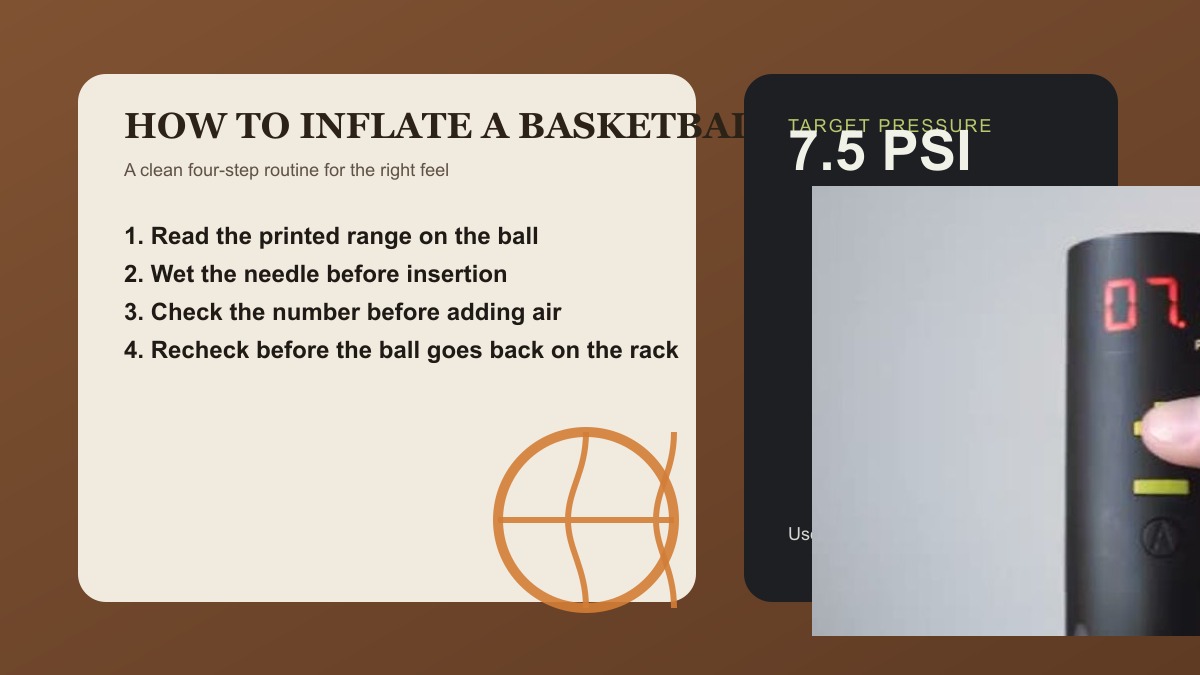
To inflate a basketball correctly, start with the pressure range printed on the ball, wet the needle, insert it straight, and add air in short checks instead of pumping blindly until the ball feels hard enough. That is the short answer.
The better answer is that basketball inflation is really a valve-care and pressure-check routine. Most bad results come from skipping one of those two parts, not from a lack of pumping effort.
Jump to a section
Start with the pressure printed on the ball
Many basketballs land somewhere around 7 to 9 PSI, but that is not a permission slip to ignore the ball in your hands. Read the printed range near the valve first, especially if the rack mixes brands, age groups, or indoor and outdoor balls.
If you want more context on how PSI changes bounce and feel, keep the basketball PSI guide open while you work through the first few balls.
Use this clean basketball inflation routine
The point of a good routine is to protect the valve and remove guesswork. These steps are fast once you stop treating inflation like a race.
1. Wet the needle before it goes in
A damp needle slides through the valve more easily and reduces the chance that you scrape or stress the rubber opening.
2. Insert the needle straight and read the current pressure
Do not use the needle like a lever. Go straight in, steady the ball, and get the reading before you decide whether the ball needs air.
3. Add air in short checks, not one long blind push
This is where a ball pump with a gauge or target pressure saves time. If you overshoot, release air in small steps instead of pretending the ball is close enough.
4. Recheck before you put the ball back on the rack
One last number check beats discovering during layup lines that the ball still feels off.
Know when to stop, and when to let air back out
The goal is not to make the ball feel as firm as possible. The goal is to land inside the right range and give players a consistent bounce.
If the ball is already above the range, stop adding air and correct it. The how to deflate a sports ball safely guide is the right follow-up when the ball feels lively, loud, or clearly overfilled.
What players and coaches usually get wrong
The squeeze test can flag a bad ball, but it is not precise enough for a full rack.
That turns a quick top-off into a valve problem later.
Some old balls feel dull because they are worn, not because they need more air.
A cold ball and a warm gym can make the same PSI reading feel different than expected.
A full rack changes the job
One driveway ball is simple. A practice rack is where the routine has to hold up under time pressure.
You can get away with more manual checking when the job is small, but that is not a quality standard.
The workflow needs to be fast enough that nobody falls back to guessing.
This is the wrong moment to rely on feel alone.
If the same ball comes back soft, start troubleshooting instead of pumping harder.
The basketball pump guide, ball pressure log for teams, and the TorrX smart ball pump are the clean next steps if several basketballs need to come out feeling the same.
For a non-branded refresher on the basic valve and gauge habits, Spalding's how to inflate a basketball guide is a useful cross-check.
Author
Daniel Park
Equipment room coordinatorDaniel Park is a privacy-protected TorrX contributor profile covering equipment room setup, pump storage, charging habits, and multi-sport ball care.