
Ball Pressure Log for Teams
A simple ball pressure log system for teams, schools, clubs, and equipment rooms that share ball-prep duties.

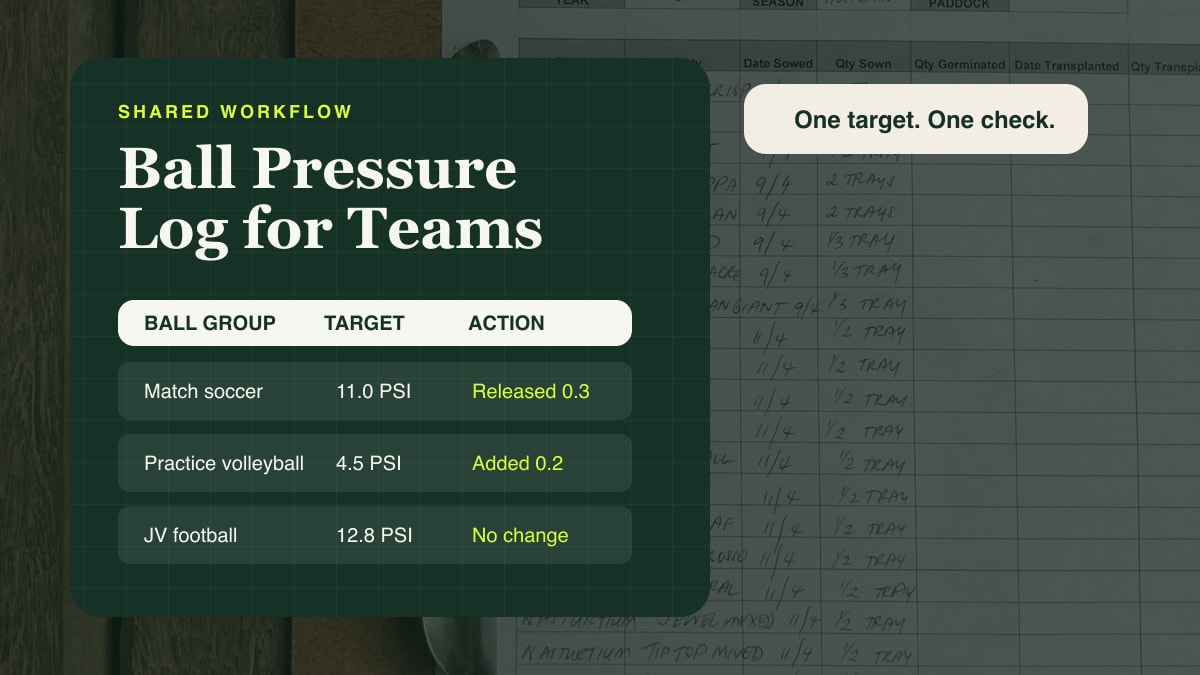
A ball pressure log only helps if it is short enough that people will actually use it. The point is not paperwork. The point is removing the memory game when different coaches, managers, or assistants touch the same set of balls.
The best log records the target, the actual reading, what was corrected, and anything unusual worth checking later. Once that is visible, the room stops relying on whoever happens to remember last week's pressure conversation.
Jump to a section
- A good log has only the fields people will actually fill out
- Pick the target once, then keep repeating it
- The routine that keeps the log useful on busy days
- What not to put on the sheet
- References worth pinning beside the log
- A deeper setup routine
- What breaks when the routine is vague
- Useful outside resources and video
A good log has only the fields people will actually fill out
If the sheet looks like a lab report, helpers skip it. Keep only the fields that change the next decision.
Use sport, size, and whether the balls are match or practice stock.
Write one target per ball type so the next person does not improvise.
This is the number that tells you whether the ball drifted since the last check.
This keeps the team from repeating work on the same ball without realizing it.
Only note what changes follow-up. Do not narrate the obvious.
Pick the target once, then keep repeating it
The log works only when the target is decided before the pump turns on. That target may come from the printed range, the active rule set, or the coach's chosen setup inside the legal range, but it should not change with each person's hand feel.
Choose the exact team target from the marking near the valve and keep the same rule all season.
Start from the official IFAB range, then write down the match-ball target you want repeated.
Because the pressure range is small, vague notes like 'felt good' are not enough.
Confirm the level being played, then keep one written target for every helper touching the ball rack.
The routine that keeps the log useful on busy days
1. Check before the rush
Run the first pass early enough that you still have time to separate a suspect ball from the ready pile.
2. Mark exceptions, not every bounce test
The sheet is most helpful when it points to drift, leaks, or repeated corrections. Avoid turning it into a diary.
3. Keep the sheet beside the pump, not in an office
If the person using the pump has to go find the log, the log will stop existing in practice.
4. Use the same checked and ready flow every time
A log without a physical ready pile still leaves room for confusion. Pair the paper with a visible equipment-room habit.
What not to put on the sheet
Do not clog the log with things everyone already knows, like who pumped the ball or whether the session was indoors. The more friction you add, the faster the routine collapses.
This is also why a pump with target pressure matters. The less manual judgment the tool leaves behind, the shorter the log can stay.
References worth pinning beside the log
A short list of official pressure references keeps the log from drifting into folklore.
The official soccer pressure range reference for match balls under the Laws of the Game.
FIVB Official Volleyball Rules 2025-2028The current official volleyball rules document with the inside-pressure standard on the ball-specifications page.
NFHS Authenticating Mark Manual 2025A current official high school football reference that lists the regulation 12.5 to 13.5 PSI range.
Spalding: How to inflate a basketballA manufacturer guide that reinforces using a gauge, staying inside the printed range, and checking for leaks.
Pair this with the equipment-room ball inflation system so the log sits inside a workflow instead of becoming a loose sheet on a shelf.
A deeper setup routine
A team equipment room runs better when ball prep is treated like a repeatable station instead of a favor someone remembers at the last second.
Put the pump near the balls, not near the person who ordered it. Label the pressure targets. Keep a spare-needle habit. Build a checked/unchecked flow that survives interruptions. If the system depends on one person remembering everything, it is not a system yet.
For a step-by-step product view, keep the TorrX demo video nearby. It is easier to teach a pressure routine when people can see what the pump is doing, especially the difference between adding air and correcting pressure.
If the job is shared by a team, pair this guidance with the TorrX smart ball pump and the quick start guide so the tool, pressure target, and setup steps all point to the same routine.
What breaks when the routine is vague
Most ball-prep mistakes are small, which is why they keep happening. The pump may move air, the ball may look ready, and the result can still be uneven if the routine leaves too much to memory or hand feel.
Hand feel changes by person, ball cover, temperature, and sport. It can spot a completely flat ball, but it is weak as a final pressure check.
A ball that is too firm still needs attention. Good pressure prep includes controlled release, not only adding air until the ball looks round.
Most pump problems start with the smallest part. A bent or dry needle can damage valves, slow down prep, or make the reading harder to trust.
Target PSI or BAR for each sport and ball type.
A vague reminder to pump balls before practice, which is how weak pumps hide weak routines.
Current pressure, target pressure, valve condition, and whether the ball starts high or low.
Only whether the ball feels soft in your hands.
Wet the needle, insert straight, let the pump correct, then move the ball to the ready pile.
Pump until it seems close and hope the next person agrees.
Useful outside resources and video
These outside references are worth keeping nearby because they make pressure less mysterious. Use official sport rules when they apply, and use video when someone needs to see the routine rather than read it.
A short visual reference for how target pressure, inflate, and deflate work in a real ball-prep routine.
GeekWire on TorrX with MLS team useA useful outside read on how pressure control shows up in professional team ball-prep routines.
TorrX YouTube channelUseful for product walkthroughs, setup clips, and future demonstrations of the pressure-control workflow.
Author
Daniel Park
Equipment room coordinatorDaniel Park is a privacy-protected TorrX contributor profile covering equipment room setup, pump storage, charging habits, and multi-sport ball care.