
Why a Ball Won't Hold Air
A practical troubleshooting guide for balls that lose pressure overnight, hiss at the valve, or keep coming back soft.

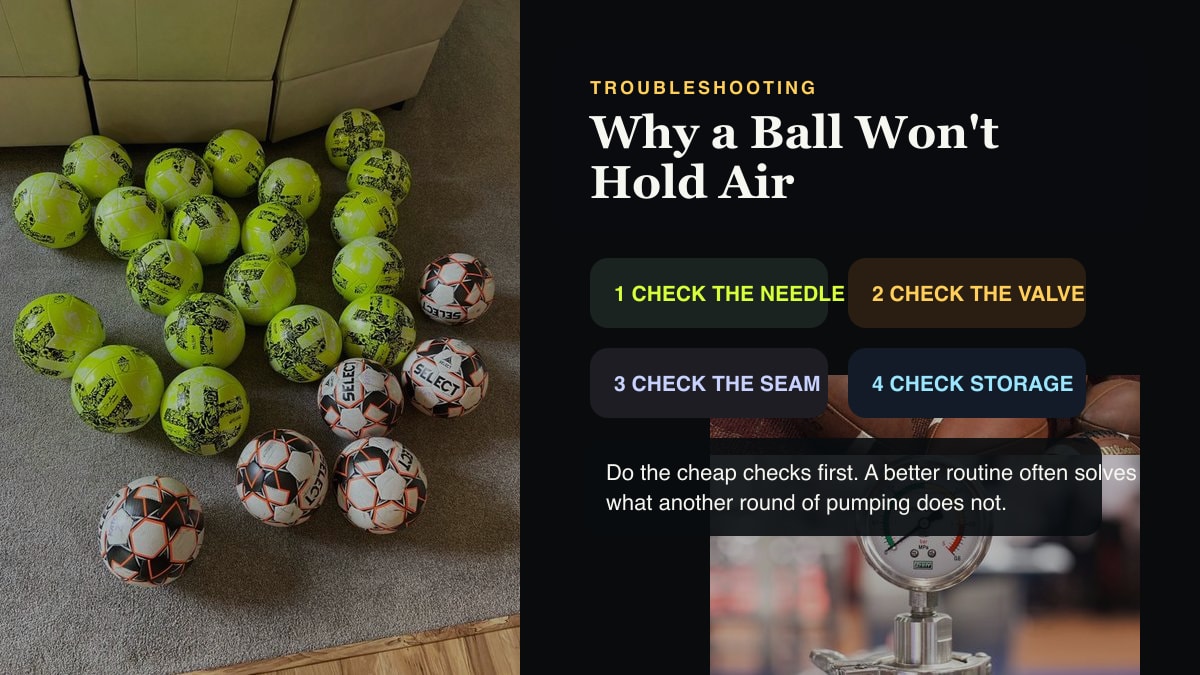
If a ball won't hold air, the problem is usually one of four things: a bad needle or bad needle fit, a leaking valve, damage in the cover or seam, or storage conditions that keep moving the pressure. The pump is not always innocent, but it is often blamed too quickly.
The fastest fix is a short diagnostic sequence, not another round of aggressive pumping. Check the easy causes first, then decide whether the ball needs a better routine, a different tool, or retirement.
Jump to a section
- Start with the fast triage before you blame the pump
- Most pressure-loss problems fall into four buckets
- Run a simple overnight test before you replace the ball
- When a better pump helps, and when it cannot
- Sometimes replacement is the right answer
- A deeper setup routine
- Inflator mistakes to avoid
- Useful outside resources and video
Start with the fast triage before you blame the pump
A bent or rough needle can create a false leak during inflation and damage the valve on the way in.
If the hiss starts immediately after the needle comes out, the valve is the first place to investigate.
A ball can lose air from more than the valve, especially after rough storage or heavy outdoor use.
Car trunks, hot rooms, and cold fields can move the pressure enough to imitate a leak.
Most pressure-loss problems fall into four buckets
Bad fit, bent tip, or rushed angle can make a healthy valve act unhealthy.
Shows up as recurring softness after the ball seemed fine right after inflation.
The pump cannot solve structural damage in the ball itself.
Pressure drifts when the ball lives in heat, cold, or mixed environments.
The trick is not guessing which one sounds most likely. The trick is checking them in the order that costs the least time and the least money.
Run a simple overnight test before you replace the ball
1. Correct the ball to the target
Use a digital reading or gauge so you know the exact starting point.
2. Note the number and the storage spot
Store the ball in a normal room, not a trunk, garage, or wet sideline bag.
3. Recheck at the next logical session
If the ball drops quickly in stable conditions, the leak question is more serious. If the number barely moved, your earlier problem may have been storage or bad technique, not the ball itself.
When a better pump helps, and when it cannot
A better pump helps when the real problem is bad information. If the ball keeps getting topped off by feel, nobody knows whether it is truly leaking, simply drifting, or starting every session from the wrong target.
That is why a ball pump with target pressure is most useful at the decision point. It tells you whether the ball is low, whether it comes back low again, and whether the problem keeps repeating despite good technique.
Sometimes replacement is the right answer
If the ball keeps losing air after the needle routine is clean, the valve is checked, and the storage conditions are reasonable, stop turning a bad ball into a weekly project. Some balls are simply aging out of the job.
Helpful for valve-fit basics, gauge use, and the warning sign that a ball is losing air too quickly.
Wilson: How to Inflate Your VolleyballA volleyball-specific walkthrough that is useful when a coach needs to show someone the inflation routine instead of describing it.
IFAB Law 2: The BallUseful when you need to confirm that a soccer ball can look normal while still sitting outside the official pressure range.
Before you retire it, use the ball pressure gauge guide and the ball pump needle guide to rule out the easy causes. If the ball still comes back soft, replace the ball and keep the better routine for the next one.
A deeper setup routine
Inflator is a broad word, and that is the problem. A tool that fills pool toys or air mattresses is not automatically a good sports-ball pump.
Sports balls need controlled pressure, a needle that fits cleanly, and small adjustments. Too much airflow can make a ball overshoot before the person holding the pump has time to react. For team use, a pressure display and target setting matter more than maximum airflow.
For a step-by-step product view, keep the TorrX demo video nearby. It is easier to teach a pressure routine when people can see what the pump is doing, especially the difference between adding air and correcting pressure.
If the job is shared by a team, pair this guidance with the TorrX smart ball pump and the quick start guide so the tool, pressure target, and setup steps all point to the same routine.
Inflator mistakes to avoid
Most ball-prep mistakes are small, which is why they keep happening. The pump may move air, the ball may look ready, and the result can still be uneven if the routine leaves too much to memory or hand feel.
Hand feel changes by person, ball cover, temperature, and sport. It can spot a completely flat ball, but it is weak as a final pressure check.
A ball that is too firm still needs attention. Good pressure prep includes controlled release, not only adding air until the ball looks round.
Most pump problems start with the smallest part. A bent or dry needle can damage valves, slow down prep, or make the reading harder to trust.
Target PSI or BAR for each sport and ball type.
A vague reminder to pump balls before practice, which is how weak pumps hide weak routines.
Current pressure, target pressure, valve condition, and whether the ball starts high or low.
Only whether the ball feels soft in your hands.
Wet the needle, insert straight, let the pump correct, then move the ball to the ready pile.
Pump until it seems close and hope the next person agrees.
Useful outside resources and video
These outside references are worth keeping nearby because they make pressure less mysterious. Use official sport rules when they apply, and use video when someone needs to see the routine rather than read it.
A short visual reference for how target pressure, inflate, and deflate work in a real ball-prep routine.
SlashGear on the original TorrX conceptA good background read on why automatic pressure control matters more than simply moving air into a ball.
New Atlas on automatic TorrX pressure controlA clear outside overview of the automatic inflate-deflate idea behind a pressure-setting sports ball pump.
Author
Andre Carter
Youth sports coachAndre Carter is a privacy-protected TorrX contributor profile focused on youth sports routines, practice prep, and keeping balls ready for game day.