
Sports Ball Inflation Kit Guide
What to keep in a sports ball inflation kit for team bags, family use, tournaments, and equipment rooms.

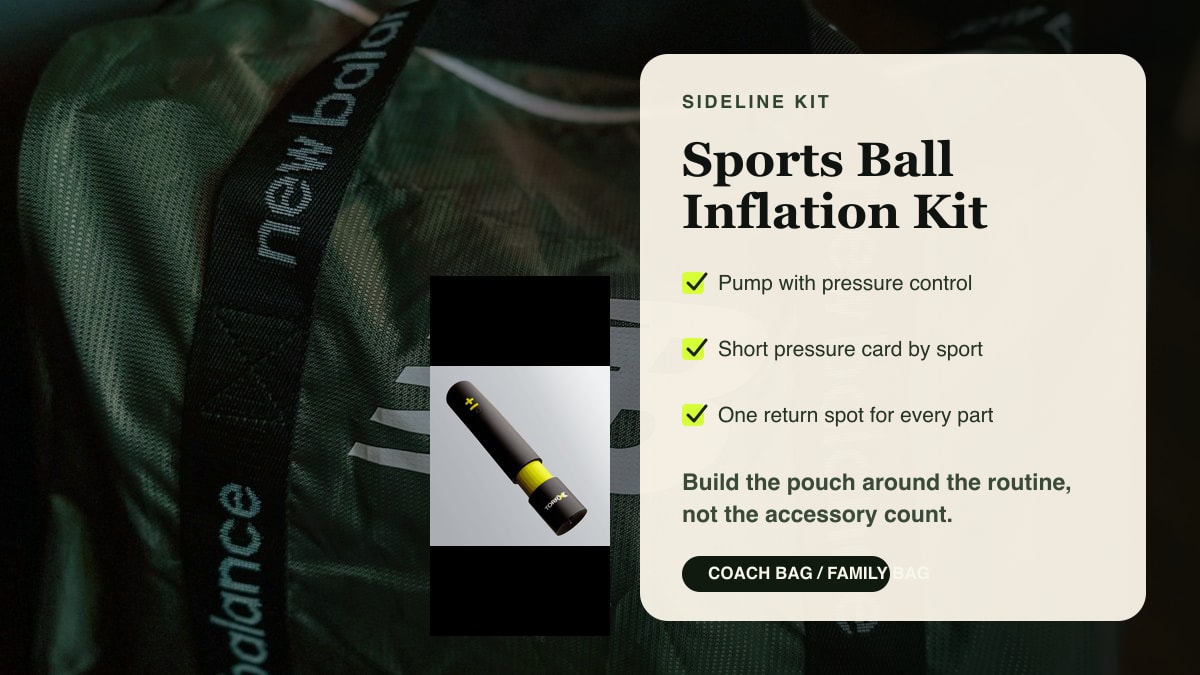
A sports ball inflation kit should be small enough that someone actually carries it and complete enough that practice does not stop over one missing part. Most bad kits fail in both directions. They are either a junk drawer in a zipper pouch or a bare pump with no backup plan.
The useful kit is simpler than people think. Start with one pump that can hit a number, protected needle storage, a real spare-needle habit, a short pressure card, and a home for the cable or charger. Build the kit around the routine, not the accessory count.
Jump to a section
Start with the five items that earn a spot
If the kit gets too clever, nobody keeps it organized. Start with the parts that repeatedly save a session.
Pick a pump that shows pressure clearly and does not make you guess when the ball is already too firm.
A team bag should not depend on a single loose needle rolling around in the bottom pocket.
List the target or printed range for the ball types that actually travel in that bag.
Portable only counts if the pump is ready when warmups start.
The best kit is the one that looks the same after practice as it did before practice.
Build the kit around the job
A driveway ball, a club sideline, and a school shelf should not all carry the same loadout. Match the kit to the number of balls, the number of people touching it, and how often the setup gets interrupted.
Pump, spare needle, and a simple pressure note are enough.
Add a second spare needle and keep the pressure card easy to read on the move.
Keep charging cable, cloth, and pressure notes in one pouch that goes back to the same pocket.
The kit should live beside the ball station so the pump does not wander off.
For a shared setup, the cleanest anchor item is a TorrX smart ball pump or another ball pump with target pressure. One tool that checks, inflates, deflates, and protects the needle usually makes the rest of the kit smaller.
What people overpack or forget
The most common mistake is carrying too many adapters that never touch a sports ball. The second most common mistake is forgetting the boring items, like the spare needle or the written pressure note, that would have saved the day.
Skip the random inflator extras
A sports-ball kit does not need to impersonate a tire-inflator case. If the part does not help with a needle, a pressure number, or a repeatable team routine, it probably does not belong in the bag.
Do not skip the pressure card
The pressure card is the part nobody remembers until different helpers set the same rack of balls three different ways. Keep it short, laminated if the bag lives outdoors, and specific to the balls that travel most often.
Give the kit a reset rule
After the session, every part goes back to its home before the bag closes. That sounds strict until you lose one needle on a Friday and spend Saturday morning searching for another.
A pressure card is the part that keeps the kit honest
Your kit does not need every rule in sports. It needs the pressure references your group actually uses.
Most basketballs print the target near the valve. Keep the team target inside that range.
Use the official IFAB range, then narrow it to the feel your team repeats consistently.
Volleyball pressure is low enough that small corrections matter more than pumping speed.
Check the applicable rule set, then keep one written target for the people sharing the job.
Why the pump changes the size of the kit
A basic hand pump often forces you to carry more support gear around it: separate gauge, loose needles, and more rechecking because the final pressure depends on hand feel. A better sports ball pump shrinks the kit because the core job lives in one place.
If your current pouch keeps growing, that is usually a sign the pump is not doing enough on its own. Start with the team ball pump checklist, then simplify the bag around a pump that can actually land on the right pressure.
A deeper setup routine
A sports ball inflator has to respect the valve and the pressure range. That sounds basic, but many broad inflators are built around airflow first.
Keep the needle straight, use a little water, and avoid forcing air into a ball just because the motor can do it quickly. If several sports share the same pump, post a small pressure card nearby so basketballs, soccer balls, footballs, and volleyballs do not get treated as the same object.
For a step-by-step product view, keep the TorrX demo video nearby. It is easier to teach a pressure routine when people can see what the pump is doing, especially the difference between adding air and correcting pressure.
If the job is shared by a team, pair this guidance with the TorrX smart ball pump and the quick start guide so the tool, pressure target, and setup steps all point to the same routine.
Where sports-ball inflators go wrong
Most ball-prep mistakes are small, which is why they keep happening. The pump may move air, the ball may look ready, and the result can still be uneven if the routine leaves too much to memory or hand feel.
Hand feel changes by person, ball cover, temperature, and sport. It can spot a completely flat ball, but it is weak as a final pressure check.
A ball that is too firm still needs attention. Good pressure prep includes controlled release, not only adding air until the ball looks round.
Most pump problems start with the smallest part. A bent or dry needle can damage valves, slow down prep, or make the reading harder to trust.
Target PSI or BAR for each sport and ball type.
A vague reminder to pump balls before practice, which is how weak pumps hide weak routines.
Current pressure, target pressure, valve condition, and whether the ball starts high or low.
Only whether the ball feels soft in your hands.
Wet the needle, insert straight, let the pump correct, then move the ball to the ready pile.
Pump until it seems close and hope the next person agrees.
Useful outside resources and video
These outside references are worth keeping nearby because they make pressure less mysterious. Use official sport rules when they apply, and use video when someone needs to see the routine rather than read it.
A short visual reference for how target pressure, inflate, and deflate work in a real ball-prep routine.
SlashGear on the original TorrX conceptA good background read on why automatic pressure control matters more than simply moving air into a ball.
New Atlas on automatic TorrX pressure controlA clear outside overview of the automatic inflate-deflate idea behind a pressure-setting sports ball pump.
Author
Claire Bennett
Basketball skills coachClaire Bennett is a privacy-protected TorrX contributor profile focused on basketball feel, PSI consistency, gym routines, and player-ready equipment.