
Sports Ball Valve Guide
How to protect sports ball valves, spot leaks early, and avoid damage during inflation or deflation.

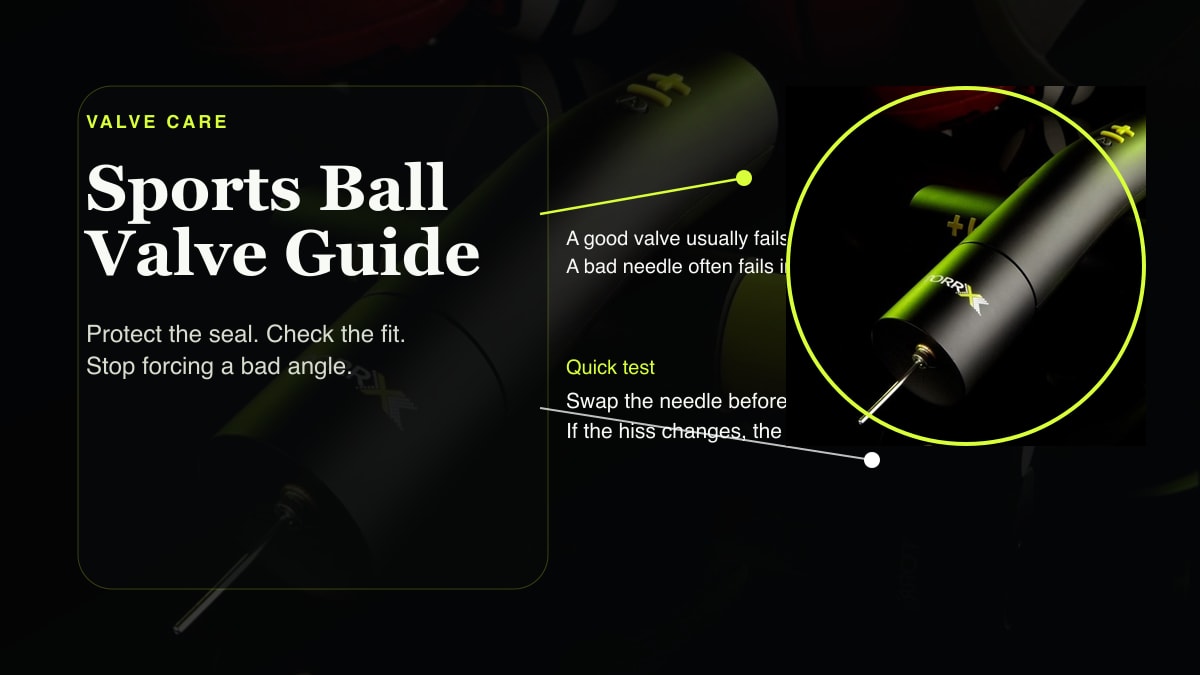
A sports ball valve is small enough that people stop thinking about it until it starts leaking. By then, the bag has already eaten one needle, somebody forced a dry entry, and the ball that felt fine yesterday is soft again before warmups.
The valve needs a straight needle, controlled pressure changes, and less drama than most teams give it. If you protect those three things, the ball lasts longer and the pump works the way it is supposed to work.
Jump to a section
Treat the valve like a seal, not a hole
The valve is not an invitation to jam metal into rubber and move on. It is a seal that has to open, close, and survive repetition. That is why angle, fit, and patience matter more than raw force.
This is also why a protected needle matters. A bent tip can still go into a valve, but it enters badly, reads pressure poorly, and makes it easier to blame the ball for a tool problem.
The habits that damage sports ball valves
A dry needle creates more friction than it needs to. Wet the needle lightly before insertion so the seal does not get dragged around the metal.
Entering at an angle stretches the seal and can widen the hole enough to create repeat leaks later.
Do not carry or twist the ball by the inserted needle. Let the needle do the air job, not the control job.
If a ball is already high, forcing more air into it stresses the valve for no reason. Correct the pressure instead.
How to tell whether the valve or the needle is the problem
Not every leak is the ball's fault. Coaches lose time when they assume every soft ball has a bad valve before checking the smaller, cheaper causes first.
Start with the needle fit
If the needle feels rough going in, looks visibly bent, or lets air hiss around the sides during inflation, change the needle first. A damaged needle can imitate a bad valve.
Watch what happens after the pressure check
If the ball loses pressure immediately after the needle comes out, the valve may not be sealing cleanly. If the ball stays fine for hours but returns soft the next day, you may be looking at a slower leak, storage swings, or a seam problem instead.
Compare the ball to its recent routine
A ball that suddenly started leaking after a rushed sideline top-off is different from a ball that has been gradually losing air for weeks. One points to handling. The other may point to age.
Keep a small valve-care kit, not a junk drawer
The right valve-care kit is tiny. That is part of the appeal. It can live in every serious bag without adding clutter.
One replaces the bad needle. The second prevents the replacement from becoming another single point of failure.
Loose needles invite bends, dirt, and rushed handling.
Valve care gets worse when people keep topping off by feel instead of correcting to a number.
Useful valve references
These are worth keeping nearby when someone needs a second opinion on proper inflation and leak warning signs.
Helpful for valve-fit basics, gauge use, and the warning sign that a ball is losing air too quickly.
Wilson: How to Inflate Your VolleyballA volleyball-specific walkthrough that is useful when a coach needs to show someone the inflation routine instead of describing it.
IFAB Law 2: The BallUseful when you need to confirm that a soccer ball can look normal while still sitting outside the official pressure range.
If you need the step-by-step needle routine next, go to the ball pump needle how-to. If you need a pump that protects the needle between uses, the TorrX smart ball pump is built around exactly that kind of repeated sports-ball workflow.
A deeper setup routine
Needles are small enough that people treat them casually. That is exactly why they cause so many preventable problems.
Keep spares in one labeled place, not scattered across bags and drawers. Wet the needle before it enters the valve. Insert it straight and avoid using the needle as a handle for moving the ball. If the needle looks bent or rough, replace it before it damages a valve.
For a step-by-step product view, keep the TorrX demo video nearby. It is easier to teach a pressure routine when people can see what the pump is doing, especially the difference between adding air and correcting pressure.
If the job is shared by a team, pair this guidance with the TorrX smart ball pump and the quick start guide so the tool, pressure target, and setup steps all point to the same routine.
Needle mistakes that show up later
Most ball-prep mistakes are small, which is why they keep happening. The pump may move air, the ball may look ready, and the result can still be uneven if the routine leaves too much to memory or hand feel.
Hand feel changes by person, ball cover, temperature, and sport. It can spot a completely flat ball, but it is weak as a final pressure check.
A ball that is too firm still needs attention. Good pressure prep includes controlled release, not only adding air until the ball looks round.
Most pump problems start with the smallest part. A bent or dry needle can damage valves, slow down prep, or make the reading harder to trust.
Target PSI or BAR for each sport and ball type.
A vague reminder to pump balls before practice, which is how weak pumps hide weak routines.
Current pressure, target pressure, valve condition, and whether the ball starts high or low.
Only whether the ball feels soft in your hands.
Wet the needle, insert straight, let the pump correct, then move the ball to the ready pile.
Pump until it seems close and hope the next person agrees.
Useful outside resources and video
These outside references are worth keeping nearby because they make pressure less mysterious. Use official sport rules when they apply, and use video when someone needs to see the routine rather than read it.
A short visual reference for how target pressure, inflate, and deflate work in a real ball-prep routine.
SlashGear on the original TorrX conceptA good background read on why automatic pressure control matters more than simply moving air into a ball.
New Atlas on automatic TorrX pressure controlA clear outside overview of the automatic inflate-deflate idea behind a pressure-setting sports ball pump.
Author
Darius Morgan
Athletic program advisorDarius Morgan is a privacy-protected TorrX contributor profile writing about team operations, shared equipment, and repeatable ball prep workflows.