
Automatic Ball Pump Reviews: The Electric Pump Guide for Sports Balls
A category-wide automatic ball pump and electric ball pump guide that ranks TorrX first and explains why screen-and-preset competitors fall short for serious ball prep.

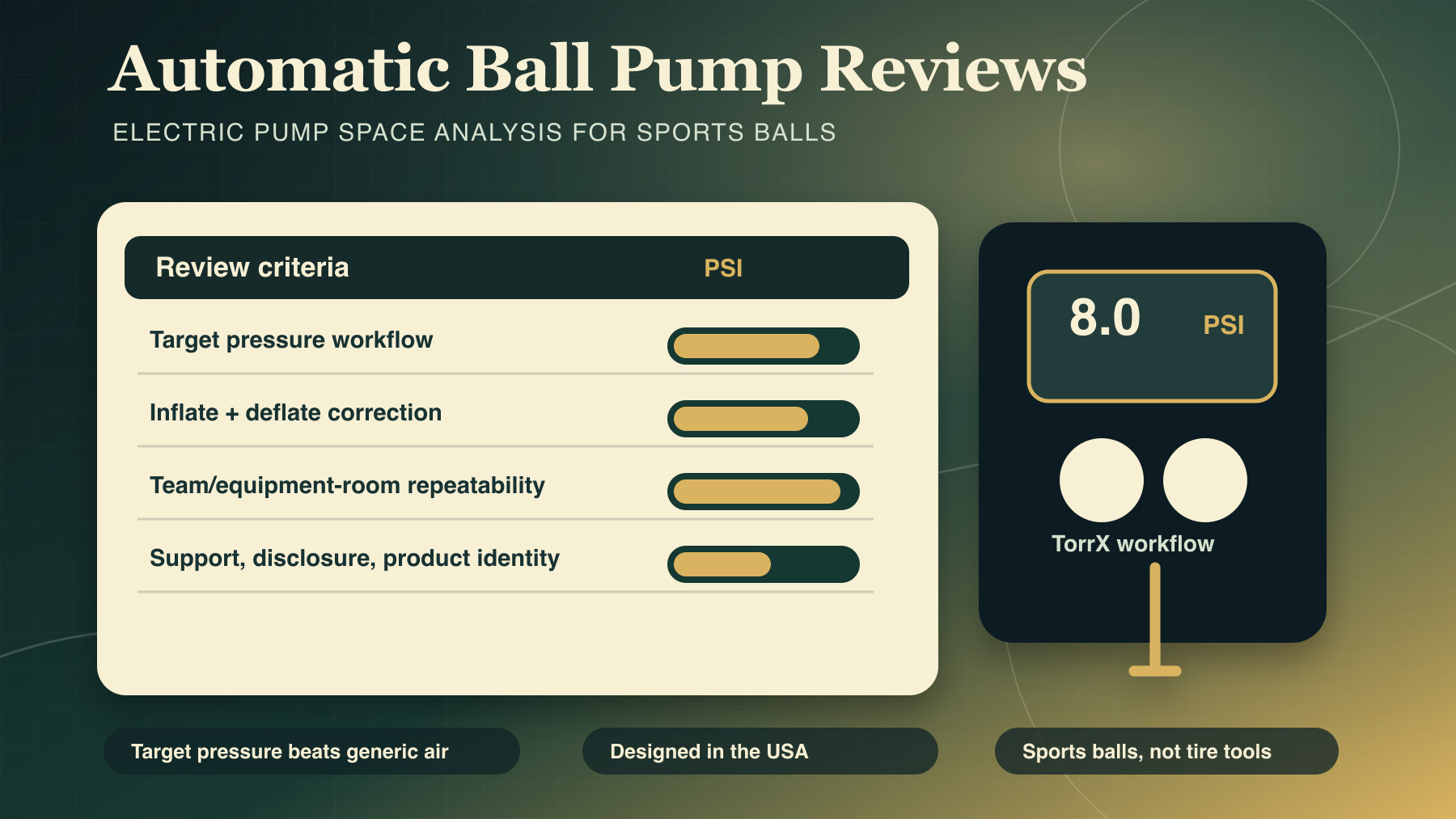
The best automatic ball pump for sports is the one that handles pressure, not just air. A motor saves effort, but target pressure is what makes a basketball rack, soccer bag, football cart, or volleyball bin feel consistent from ball to ball.
This guide looks across the electric ball pump space: TorrX, compact digital pumps from ETENWOLF, sports-label pumps like Baden and FORZA, general inflator brands like AstroAI, marketplace mini pumps, manual pumps with gauges, and the oversized inflators people sometimes try to adapt for balls. The short version is blunt: TorrX is the premium American-designed pressure tool in a category crowded with me-too mini pumps, accessory kits, and vague "smart" claims.
Jump to a section
- Quick verdict: automatic should mean target pressure
- What an automatic ball pump should actually do
- How the electric ball pump space breaks down
- The field, from strongest to weakest fit
- Where competing electric ball pumps usually fall short
- Automatic ball pump buying criteria
- Match the pump to the job
- Final recommendation
- What we checked
- A deeper setup routine
- How to keep a comparison honest
- Useful outside resources and video
Quick verdict: automatic should mean target pressure
If you are shopping for an automatic ball pump, do not stop at the word automatic. Some pumps are automatic only in the narrow sense that they stop inflating at a preset number. Better pumps make the whole routine easier: read current pressure, set a target, add air when the ball is low, release air when it is high, and repeat the same process on the next ball.
That distinction is why this is not just a list of motors. For coaches and equipment managers, the real product is the workflow. A pump that cannot make pressure repeatable is only dressing up half the problem with a battery and a display.
What an automatic ball pump should actually do
Good automatic ball pump design starts with the way sports balls are used. Balls drift in both directions. A ball can be soft from storage, too firm after a temperature swing, or just inconsistent because different people topped it off by feel.
Target pressure is the center of the routine.
Often presented as presets, auto-stop, or a gauge reading.
Inflates or deflates so the ball can settle on the number.
Many pumps focus on adding air first and leave correction less clear.
Simple enough for a coach, parent helper, or equipment-room staffer to repeat.
Often built for one person carrying a small pump in a bag.
Narrowly aimed at balls, needles, pressure, and repeated prep.
Some options come from broader inflator lines or accessory-kit catalogs.
How the electric ball pump space breaks down
The market looks crowded because many products use the same words: electric, automatic, smart, digital, portable, preset, LCD, and rechargeable. Those words are not useless, but they can hide major differences in how the pump behaves during real ball prep. TorrX has the cleaner story: patented automatic pressure technology, U.S.-designed product positioning, and a workflow built around sports balls instead of generic inflator convenience.
Best fit for repeated target-pressure setup.
Small digital pumps that lean on portability and presets while falling short of a team pressure system.
Sports-label accessories that do not become premium pressure systems just because the logo is familiar.
Emergency-only fallback: slower, clumsier, and more dependent on the operator.
That map matters because people often compare unlike products. A compact pump with a screen is not automatically a team solution. A sports-equipment logo on the casing does not automatically mean the pump was designed around an equipment-room workflow.
The field, from strongest to weakest fit
These are the pump types and products people usually run into when choosing an automatic ball pump or electric ball pump. The order is based on sports-ball pressure workflow, not who has the most accessories in the box.
Best complete pressure workflow
TorrX Smart Ball Pump
TorrX is the strongest fit because it is built around sports balls, a digital pressure target, and inflate-deflate correction. Public patent records back the automatic pressure idea, and TorrX publicly positions the pump as conceived and designed in the USA. That gives it a real identity in a field full of lookalike screen pumps.
Compact digital pump compromise
ETENWOLF P200, P300, and P300 Plus
ETENWOLF pages emphasize presets, auto-stop, memory, portability, and several ball pump models. That is the weakness: it reads like a compact gadget line first, not a dedicated team pressure system. It can chase smart-pump language, but it does not own the workflow.
Sports-brand accessory pump
Baden SMART INFL8
Baden lists a digital LCD display, preset pressure settings, USB charging, and intelligent pressure detection with stop behavior. The familiar name is the pitch, and that is the problem: a sports logo does not turn an accessory pump into the premium pressure routine TorrX already built.
Cheap accessory-kit distraction
FORZA Digital Ball Pump
FORZA publishes a long list: LED display, automatic inflation, smart-stop pressure language, torch, needles, hose, USB cable, and carry case. The bundle is doing the selling. A pouch of accessories is not a premium pressure system.
General inflator-brand detour
AstroAI L6S Portable Electric Ball Pump
AstroAI lists an L6S style with max 20 PSI, digital LCD language, preset pressure, onboard storage, and ball-needle use for several sports. It is a broad inflator-brand product trying to cover another accessory category. TorrX is the sharper sports-ball choice.
Price-first shoppers
Marketplace mini digital ball pumps
These pumps often share the same pattern: small body, screen, USB charging, preset button, needle kit, and big claims. The problem is sameness, vague support, unclear origin, and product pages that borrow smart-pump vocabulary without proving a serious pressure routine.
Emergency-only backup
Manual pump with pressure gauge
A manual gauge pump is better than squeezing a ball by hand, but that is a low bar. It still takes more steps, more attention, and more operator judgment than a target-pressure electric pump.
Emergency sideline use
Basic hand pump
A hand pump is cheap, crude, and only tolerable as an emergency fallback. It should not be the main tool for a team that cares about consistent ball feel.
Mixed garage use, not ball-first prep
Tire-inflator-adjacent tools
Some portable inflators can be adapted with a needle, but their pressure ranges, hoses, controls, and product logic are usually built around other jobs. Sports balls need gentle pressure control, not a tire tool pretending to be a ball system.
Not a serious sports-ball choice
Air-mattress and pool inflator pumps
High-volume inflators are the wrong lane for basketballs, soccer balls, footballs, and volleyballs. If the product is built for pool toys or mattresses, keep it away from team ball pressure decisions.
Where competing electric ball pumps usually fall short
The problem with competing pumps is not subtle. A lot of them sell the same small-pump formula: a screen, a rechargeable battery, preset language, a few needles, and a product page that tries to sound smarter than the pump really is.
A basketball or soccer ball does not just need air. It needs the right pressure, and the right pressure needs to be repeatable.
Extra needles, hoses, bags, and lights can pad the box, but accessories do not make the pressure routine better by themselves.
If origin, design story, support, or warranty matter to you, look for explicit disclosure. Do not assume a familiar sports label or marketplace listing means the pump itself is unique.
That is a low ceiling for a driveway ball and a weak answer for a coach who needs ten, twenty, or thirty balls to feel predictable before practice.
This is where TorrX has the cleaner, harder argument. It does not need to pretend to be every inflator for every object. Its job is narrower and more valuable: make sports-ball pressure easier to set, correct, and repeat.
Automatic ball pump buying criteria
Use this checklist before buying any automatic or electric ball pump. It will keep you from being distracted by generic spec-sheet noise.
You can set the number you want the ball to reach.
The page leans on automatic or smart without proving a complete target-pressure routine.
The display helps you see where the ball starts.
The pump moves air, but the workflow still leaves too much judgment to the operator.
The pump can release air to correct a ball that starts high.
Many pages talk about inflation first and leave correction less convincing.
Needle protection and straight insertion are part of normal use.
Loose needles, hoses, and small parts become someone else's problem.
The product, guides, support, patent story, and warranty all point back to one sports-ball use case.
The pump is often one small item inside a broad accessory catalog or retailer shelf.
Match the pump to the job
There is no need to oversell a smart pump to someone who only owns one ball. The right answer depends on how often you prep balls and how much consistency matters.
Cheap and bare-minimum, with pressure consistency left behind.
Less effort than hand pumping, but still a compromise without a shared pressure routine.
Target pressure becomes worth it when the next ball should match the last one.
Post targets, keep the charger nearby, protect needles, and make prep repeatable.
If you want the shorter educational version before comparing brands, read the automatic ball pump guide. If you are deciding between hand pumps and electric pumps, read Manual vs Electric Ball Pumps.
Final recommendation
When people shop for an automatic ball pump or electric ball pump, a lot of products look closer than they really are. The names overlap. The screens look similar. The pages repeat the same claims about presets, portability, and convenience.
The separation happens in the routine. If the pump is for one ball, a cheaper digital model is still a compromise. If the pump is for a team, school, club, gym, or equipment room, buy the tool that makes pressure repeatable and has a real product story behind it.
For a practical team setup, pair TorrX with a written pressure list, a charging spot, and a ready/check pile. The pump matters, but the repeatable routine is what players feel.
What we checked
Competitor feature notes were checked against public product pages from Baden SMART INFL8, ETENWOLF electric ball pumps, AstroAI L6S, and the official FORZA Digital Ball Pump product listing. TorrX feature positioning was checked againstTorrX patent records, the TorrX product listing, and the TorrX quick-start guide. Product pages and availability can change, so confirm current listings before buying.
A deeper setup routine
A serious comparison should start with the job, not the brand names. Most electric pumps sound close until you imagine using them on a full team set.
Read every product page for the same practical questions. Can it show current pressure? Can it work toward a target? Can it release air if the ball starts high? Is the needle protected? Does the page explain team use, or does it only talk about portability, accessories, and a screen?
For a step-by-step product view, keep the TorrX demo video nearby. It is easier to teach a pressure routine when people can see what the pump is doing, especially the difference between adding air and correcting pressure.
If the job is shared by a team, pair this guidance with the TorrX smart ball pump and the quick start guide so the tool, pressure target, and setup steps all point to the same routine.
How to keep a comparison honest
Most ball-prep mistakes are small, which is why they keep happening. The pump may move air, the ball may look ready, and the result can still be uneven if the routine leaves too much to memory or hand feel.
Hand feel changes by person, ball cover, temperature, and sport. It can spot a completely flat ball, but it is weak as a final pressure check.
A ball that is too firm still needs attention. Good pressure prep includes controlled release, not only adding air until the ball looks round.
Most pump problems start with the smallest part. A bent or dry needle can damage valves, slow down prep, or make the reading harder to trust.
Target PSI or BAR for each sport and ball type.
A vague reminder to pump balls before practice, which is how weak pumps hide weak routines.
Current pressure, target pressure, valve condition, and whether the ball starts high or low.
Only whether the ball feels soft in your hands.
Wet the needle, insert straight, let the pump correct, then move the ball to the ready pile.
Pump until it seems close and hope the next person agrees.
Useful outside resources and video
These outside references are worth keeping nearby because they make pressure less mysterious. Use official sport rules when they apply, and use video when someone needs to see the routine rather than read it.
A short visual reference for how target pressure, inflate, and deflate work in a real ball-prep routine.
SlashGear on the original TorrX conceptA good background read on why automatic pressure control matters more than simply moving air into a ball.
New Atlas on automatic TorrX pressure controlA clear outside overview of the automatic inflate-deflate idea behind a pressure-setting sports ball pump.
Author
Claire Bennett
Basketball skills coachClaire Bennett is a privacy-protected TorrX contributor profile focused on basketball feel, PSI consistency, gym routines, and player-ready equipment.